Showing posts with label art. Show all posts

Wednesday, July 8, 2020

Paintadog!


This is a somewhat Sydney-centric post, but it is a beautiful idea shared by a friend. It encourages artists, it supports bushfire recovery, and it celebrates dogs. So I am posting it here.


Paintadog
Paint and help us make history! Enter the first ever Blackheath village dog art competition in Springtime 2020

Do you have a dog? Enjoy painting? Then be part of a history-making event and enter a painting of your dog, or someone else’s dog in the inaugural
Blackheath PAINTADOG competition.

The competition is open to everyone across New South Wales and will be judged in two categories: Children up to 15 years and adults.

Submissions can be drawn or painted, and must be mounted, but unframed. Initially copies of works must be submitted through our website www.paintadog.com.au with your entry form. As our space is limited we can only accept the first one hundred works from each category.

Entry to the exhibition is free and opens 11 am on Saturday October 3rd  2020.  Judging will be by a well-known local artist

A non refundable entry fee to the competition, adults $20 children $5. All profits from Paintadog will be donated to The Blackheath Rhododendrum Park, which was badly affected by the 2019-2020 bush fires.

Entries will open Monday 24th August 2020 and close on Friday 24th September 2020 Please fill out the entry form on our website and scan with your painting.

Prizes: $750 for the adult winner, $250 for The People's Choice, four $100  for the children's category. Information about other prizes from local businesses and councils, will be available closer to the date on our website.
There will be a dog parade, weather permitting.

We recommend you book your accommodation early, to avoid disappointment. There are many pet friendly Airbnb's, Stayz etc.. in and around Blackheath. A list of these will be posted on our website: www.paintadog.com.au closer to the time.
With thanks to The Blue Mountains Bush Fire Recovery Program
The RSL Blackheath
The RFS Blackheath
Jenny ward Communications Director
Henry Collins
More sponsors will be .published closer to the date

Monday, September 25, 2017

A dog friendly exhibition launch for some amazing canine-inspired art

A canine sculpture, Friends 1, by Anne Field.

There’s something about artwork that features animals…particularly those known personally by the artist. The structure, framing and composition speak volumes about the animal-human relationship.

Not your usual exhibition opening...
If you like animal-oriented art and you’re in Sydney, don’t miss the 5th annual WOOF! Art Exhibition.

It features paintings, drawings, etchings, mosaics, collages and sculptures of dogs.

A stunning sculpture of a dog with a bee.
Better still, the opening was dog friendly, with many of the artist’s muses attending, somewhat amused about all the fuss but enjoying meeting other subjects.

Socialising at the WOOF! exhibition.
It’s fascinating seeing the different ways people portray the dogs they know and love.

An eclectic collection of canine art.
The exhibition runs from 22 September through to 9 October, and features some beautiful artworks.


Monday, July 17, 2017

Wondering about human animal interactions: Wunderkammer

Silhouette of Boxing Kangaroos by artist Rod McCrae at Everglades House.

Our interactions with animals range from compassionate to cruel, but the truth is that the majority of human animal interactions are unseen and overlooked. 

The impact of our behaviour on biodiversity, the wellbeing of the environment including the climate, and the animals we use every day can be extraordinary yet often goes unremarked on. Our minor habits can have major consequences for other creatures, whole species even.

Last week I had the pleasure of viewing a confronting exhibition by former children’s book artist and taxidermist Rod McCrae called Wunderkammer (“cabinet of wonders”). McCrae explains his title thus:
“Wonder seems like such an outmoded notion in our technological age where everything is so readily explained by the scientific method. Wonder however does exist in the human imagination often triggered, yet not fully explained, by an object. Rachel Poliquin’s The Breathless Zoo: Taxidermy and the Cultures of Longing (2012) puts it thus: “From early cabinets of wonder to philosophical repositories, collections of curiosities never really displayed knowledge, rather they acted as warehouses of raw potentiality.”
One of the questions this exhibit raised for me is whether we see animals as mere curiosities – when we pay attention to them at all.


Taxidermy is a fraught art form for me because, historically, many animals were killed as trophies, only to be stuffed and preserved as curiosities by those wishing to tame and control nature or at least cram it into a museum in an ironic, obsessive attempt to document every living species before it disappears off the face of the Earth.

But this isn’t ordinary taxidermy. There are signs throughout the exhibition insisting that the animals were ethically sourced: “No animal has been harmed to make this work in the first instance; the skins are the result of death by natural causes, medical euthanasia, hunting, culling and food production and have been traded on, sometimes multiple times before they became part of this body of work. The skins of the antelopes and the baboon are the byproducts of trophy taking.”

These aren’t animals arranged like trophies. Rather they are displayed in a way that raises questions like what do we mean by humankind's dominion over animals? What responsibilities does that entail? What does stewardship mean and have we got it wrong? Why do we often see animals as waste?

If you have an interest in human animal interactions, this is a relatively small but very powerful exhibition. You can read more about the work here. 

The Gardens at Everglades House.
The original owners shifted a 40 tonne boulder to create this pool.
You can catch Wunderkammer at Everglades House, part of the historic house trust, in Leura (about a two-hour train trip from Sydney) til August 27 (its a very beautiful spot for a picnic).


Monday, January 16, 2017

Mental health resources for vet employers and students, and national galleries host dog day out

vet cook book; ploughmans lunch
The ploughperson's lunch: my variation on the ploughman's lunch. The bull terrier teapot is more for show - her lip is a bit wonky so when you pour from her she dribbles everywhere. 

As regular readers will know, one of the projects we took on last year is The Vet Cook Book, an initiative to promote collegiality in the veterinary profession.

For some it’s a bit of an odd thing for smallanimaltalk to blog about. And those who have seen me in the kitchen (not my natural environment) raise their eyebrows when they hear I am co-editing a cook book. The background is that those working in the veterinary profession have a higher rate of suicide than the general population. That’s part of it. The bigger part is that plenty of vets, nurses, kennelhands, practice managers and others suffer from stress and burnout. And that impacts them, those around them, and their patients. Not that we have a monopoly on stress. It seems the modern world is geared towards everyone feeling overwhelmed, overloaded, over-contactable yet isolated, and suffering FOMO because everyone else on social media seems to have their lives in order.

The Vet Cook Book really is a One Health/One Welfare project: we need to be well in order to look after animals to their best abilities.

As one of the editorial team I was interviewed about the project last week by Dr Jo Righetti and David Prior on 2UE (you can listen to the segment here). 

During this period we’ve uncovered some really useful resources including Heads Up, an online resource to assist in developing a mentally healthy workplace. This is a fantastic resource for veterinary practice owners and managers (as well as business owners in general). You can check it out here. 

The Australian Medical Students Association, in conjunction with its New Zealand counterpart, also produces a guidebook for medical students which covers everything from mental health care, life tips, eating well on a budget, finding the right GP for you, surviving rural rotations and  managing your finances. It is a very helpful guide and can be downloaded for free. 

The recipe for my variation of the Ploughperson's lunch pictured above is:

1 bag potato chips (corrugated are better)
1 tablespoon of cashew cheese with dill (made by Peace,Love and Vegetables but I am told those possessing a food processor can work similar miracles).
1 block of cheese (I used soy cheese)
1 carrot or parts thereof
Small tomatoes of some kind or other
Pickles (I used Grandpa Jack’s Artisan Pickles: Strong pickled onions with garlic and habaneros)
Fresh bread (note I've revived some frozen bread with my toaster in this version)
1 cup of tea

The great thing about this recipe is you don’t need to cook anything…just assemble it. Quantities can be varied according to taste and hunger.

And for those wondering what on earth this has to do with ploughmen, check out Wiki on this meal here. 


PAWS FOR ART

Over the break we visited the National Portrait Gallery to check out the Popular Pet Show (you can read our interview with curator Dr Sarah Engledow here).

This weekend, on Saturday January 21, the National Portrait Gallery will join the National Gallery of Australia to host an outdoor event for dogs. If you live in Canberra, or your dog loves a road trip, this may be the place to be.

Dogs won’t be allowed in the galleries as such, but there will be plenty of dog-friendly spaces and activities outside. For more info, click here. 

Wednesday, January 11, 2017

Interview with artist Helen Norton

Helen Norton with Cookie (image supplied by the artist).

Late last year I visited a colleague who had a stunning painting on her wall. It was a work of art called Perilous Journey by Perth-based artist Helen Norton. There was something about this image that really spoke to me (it might have been the white dog with those magic ears). I admire the way some artists are able to tell a story in one picture.

I did some research and learned that “Helen Norton left home at sixteen to spend the next ten years working and living in the most remote desert locations in Australia. Not intending on becoming an artist, her ambitions focused on immersing herself in as much adventure as was possible to extract from life. Settling in Broome in the North West led to a void in adventures so she took up the paintbrush to create a continuing invention of adventures on the canvas.
Norton continued her travels throughout the Kimberley, Pilbara and overseas. She used the experiences to inject her artwork with more complex layers of narrative. Her work gained acclaim quickly, and led to commissions from Qantas to paint two front covers for their in-flight magazines, an exhibition on the QE2, and exhibitions in London as well as successful exhibitions in Melbourne and Sydney. She currently lives in Perth WA.”

Wonderfully, she was happy to answer our questions.

What’s your day job?

I am a visual artist – working in oils, acrylics and watercolours. I also manage and operate my art publishing web business Helen Norton Art – which creates prints of my works for a more affordable product.

Your art prominently features animals, particularly dogs. Why are they a theme in your work?

I have always had animals around me of all sorts since I was born therefore I fully understand the exquisite gift they bring to humans. I find animals to be the most objective subject of all subjects despite having a deep emotional connection to animals. Using them in my work gives me a rest. During many difficult periods on my life, an animal (dog or cat) got me through my problems easily, simply because they create a sort of Tao situation by being firmly rooted in only the present, the now.  Love and food now please, and I offer you my affection and attention unending.  It does not get any more pure than that. What a great subject.

How long does it take to create a painting?

Anywhere from an hour to a few years.  It depends on so many things. Sometimes artworks might sit half finished for months because I do not know what to do to them next.  Other times things just flow instantly.

Where do you draw your inspiration?

From being alive to be frank! Therefore everything! Change brings the best inspiration I have found.  Going to a different place stimulates the creative juices.

Why do you think the human-non human animal relationship is important?

The motive of animals is hard to misconstrue (unless you are projecting skewed fantasies onto the animal), therefore animals feel to me like a bringer together of all people, a great leveller.  For those who do not like animals?  Well I believe this is only because they have not been exposed to them, therefore do not understand the simple joy animals bring to the complicated human life.

Animals have few expectations of humans. Different types of animals of course have different natures and needs. The main thing is that they are uncomplicated and for most domestic animals such as dogs and cats – they are a perfect and simple mirror on a person’s behaviour. When you take on the responsibility or custody of an animal – your level of responsibility as a human is tested. You are required to feed, shelter, train and love the animal. If you do not – that pretty much speaks volumes about your attitude to life. Give nothing and get nothing in return.  Pretty sad but often chosen as we can see by the huge amount of dogs and cats in abandoned animal shelters. I find people who really dislike animals concerning. To be frank people who dislike animals (even after having had a chance to experience their company) are usually quite narcissistic. There is no room for narcissism when you care for animals. That might sound harsh but it is accurate and I have seen it over and over.  It is spot on and nothing has proven me wrong on that.

Do you share your life with non-human animals? How did you meet?

What a funny question! Non-human animals! Yes I do. I have one cat in my care now who is 12 years old. I have not had a dog for a few years but would like to look at this again in a few years. I enjoy looking after other peoples dogs, cats, chookies, cows, horses, and all sorts now and again on house sits so that their owners can go away knowing their animals are really taken care of. I have a family member staying at home who can fill the gap for me at home but there is nothing worse than having to put your animal in a kennel to go for a break.  I have done this and never ever enjoyed my ‘break’ as I knew my animal was suffering.  Okay so some animals like the kennels, but not mine!

Any advice you’d like to share with veterinarians and future veterinarians?

I think you do a great job. To love animals, then have to witness, and deal with their suffering and illness including human cruelty must be one of the hardest but noble jobs in the world – if it’s done with compassion. Animals are ALWAYS innocent, no matter what the charge because they are animals and are living directly as themselves.

The only errors humans ever make with any assessment of animals including terrible accidents with children from say dog attacks – is that they do not understand that they are dealing with an instinctual innocent creature. Any accident is caused by either bad training, ignorance of the owner or approaching person as to the nature of the animal. E.g. if a dog is a protective aggressive breed and not respected for the dangers of this by the owner or the victim then this is not the animals fault is it? How can an animal have evil thoughts or plot a murder? Would you behave differently if it was a lion? Of course, and some breeds deserve the same respect for handling.  If a dog breed is dangerous then there should be consideration of this (the onus on the owner) to show they are protecting the dog properly from being placed in dangerous situations (for humans).

Vets would see the human stupidity on animal care over and over and if I were a vet I could find it hard to keep a stiff upper lip on this. Hail to vets!

Thank you Helen for your time. If you want to see more of Helen’s work, follow her on facebook or twitter , or check out her website.


Wednesday, December 14, 2016

Why are pets popular with artists?

Billie 2016 by Graeme Drendel  oil on canvas 51 x 40.5 cm  Collection of the artist, Melbourne
Billie 2016
by Graeme Drendel 
oil on canvas
51 x 40.5 cm 
Collection of the artist, Melbourne

We don't know much about art, but we know what we like: art featuring animals. Last month the National Portrait Gallery opened its companion animal-themed exhibition, the Popular Pet Show which we cannot wait to check out. The exhibition was curated by Dr Sarah Engledow, an historian, curator and animal lover. She took a moment to share some insights into the role of companion animals in art, as subjects, muses and just good company for artists working in isolation.

What inspired the pet portrait theme? 

I have curated several exhibitions that express simple pleasures and warm human experience. For Idle hours in 2009-2010 I selected paintings and drawings of people in quiet pursuits, reading, sewing, ironing, lying on the grass, etc. For Arcadia: sound of the sea in 2014 I chose photographs from the 1970s of boys surfing, laughing, looking at the ocean, fooling around, camping (often with dogs). This exhibition, someone described as Idle hours with more legs. 

There is a strong trend in contemporary art to depict the relationship between people and animals as strange; for animals to be used, in art, ‘in the service of dark themes’, as one leading contemporary curator put it (for example, there’s been a bit of a taxidermy revival … [Yes, I’ve noticed that – Ed]). I wanted to show that there are many contemporary Australian artists who depict the relationship between people and animals as it usually is, in my own experience: a bond of loyalty and joy. Crucially, I wanted to show the very various ways fifteen artists approach exactly the same subject; to get visitors excited about artists’ different ways of applying different kinds of paint to different surfaces.

Did you find it hard to select pet portraits, or where there many to choose from?

All the works in The Popular Pet Show are paintings, drawings and sculptures - there are no photographs. It was always intended as a warm show about our animal companions but also as a serious art show. Therefore, the works in the exhibition had to be of top quality, while making people happy as well. This is an unusual combination in art (a lot of undistinguished artists paint cats and dogs, and a lot of good artists make animals seem creepy or sinister). So, in fact, there were not many to choose from. Once I chose my artists, and told them about my vision for the show, quite a few of them created works with the exhibition in mind. Nicholas Harding, for example, created more than a dozen big new paintings just for the exhibition.  Ken Done made four portraits just for it. And so on. 

How important do you think companion animals are to artists?

Not all the artists in the exhibition have companion animals. However, those who do love them intensely. Painting can be a lonely process, intellectually and physically taxing. In extreme cases, and on intense days, an artist might not talk to another human being. At least when you have a dog you have to go out and walk and get some fresh air; you stretch out, you meet other people and you tend to talk sensibly. It’s cosy to have a companion in the studio – Lucy Culliton, who has about 160 companion animals, has all kinds of friends around her as she paints. Kristin Headlam’s dog has a basket in her studio. Darren McDonald’s dog is with him at all times. Ken Done has no dog at the moment but he said that when he did a good painting, his old dog, Spot, would bark. Ken’s family dogs are memorialised in his harbourside garden.

What species are included? Which species is most commonly portrayed and why do you think this is?

Dogs outnumber other species; I think they are the most popular pets in Australia, so it’s not surprising. Then come cats, then sheep, cattle and horses (kept as pets, not as farm animals). There are a few rabbits; quite a few native animals which are either being raised from orphanhood, or are imagined pets (including native birds); there is one lizard who lived in an artist’s garden and there is one fostered flying fox. Dogs are interesting to paint because of their variable textures and features; cats are nice to paint because of their fur. All animals with moveable ears are fun to paint – ears convey so much expression, so economically - but you have to understand how the ears attach to the body, and how they fold.

Do you cohabit with non-human companions and if so, can you tell us a bit about them? 

I do indeed cohabit with a non-human companion. Most of the dogs in the Pet Show are mongrels who have been rescued from shelters – either that, or they’re retired or unfit greyhounds. By contrast, my dog cost a fortune and came by plane from a luxurious kennel in the Hunter Valley. He is a labradoodle, whom my younger son named Acorn; and he is the very embodiment of sweetness, joy and zest for life. He is 8 ½ years old, is involved in everything, and still runs and leaps like a fool. We live in Canberra which is not called the Bush Capital for nothing. He runs morning and evening off-lead in the bush. We do have to be careful with grass seeds, so he gets a lot of brushing and bathing.

He eats the cheapest bits of free-range meat (it doesn’t make sense to me to insist on free range for us, because of cruelty issues, but buy intensively-farmed meat for him). He sleeps wherever he likes and usually has a go on everyone’s beds over the course of the night. It gives our family great pleasure to be in a position to give him such a good life. We know how lucky we are to have him, and to be able to spoil him. I have been known to make Christmas ornaments from his felted wool – some more successful than others. Having said all that, last night I clipped him (incorporating the annual clip of his tail dreadlocks, which are his pride and joy) and this morning I very pointedly did not get my wake-up cuddle. 

What have you learned about the human animal bond in curating this exhibition?

Like the beach, pets are great levellers. I found curating Arcadia that it didn’t matter what people’s socioeconomic circumstances or backgrounds were when it came to telling stories about their good times on the beach. I found curating The Popular Pet Show that everyone who loves an animal has something to talk about with anyone else who loves an animal. And when I wonder what different animals perceive, think about, experience: it’s a humbling mystery that exists day by day, right amongst us, in the form of even the humblest dog. Who needs to imagine an afterlife, or aliens?

I don’t necessarily dislike people who don’t like animals, but I can’t imagine what it would be like to be a person in whose life animals have no significance. It seems like a very barren existence to me.


Sarah, I totally agree! Thank you for answering our questions and sharing your knowledge! The Popular Pet Show opened on November 4 and runs until March 13. For more info visit the National Portrait Gallery website, where we happily discovered that you can also purchase a Ken Done dog bandana. 

Monday, September 12, 2016

Dog art, finding your calling and other news

Phil, as designed by the talented Yellow Wellies. 

Sydney-based artist “YellowWellies” created an awesome image of Phil. I’m not biased or anything, and I don’t know much about art, but I do know I like art featuring Phil!!!

Check out this stunning design here, and if you like it you can order a Phil-printed t-shirt, smartphone case, tote bag, diary, hoodie, cushion, coffee mug or, you know, all of the above.

Speaking of small dogs, check out the decorating job inhonour of this Chihuahua. There must be some miniature furniture shops around…

Is veterinary science your calling? A colleague shared this post about the idea of: “finding your calling”. The Venn Diagram is excellent, although working within that triangle of venn-overlappage is not guaranteed and doesn’t occur on a daily basis (but life is golden when you’re there).


And for those keen to be part of the first Vet Cook Book, we’ve set up a facebook page that you can follow.  https://www.facebook.com/vetcookbook/

Wednesday, February 24, 2016

Pets in history - interview with Paul Carpenter from Pompous Pets

Napoleon and Nelson
Michael and Hero, as Napoleon and Nelson, painted by Paul Carpenter.
I don’t know much about art, but I do know that art featuring non-human animals is the best kind. Which is why I was drawn to Paul Carpenter’s work. Paul creates historic portraits featuring people’s pets. I read about him in a newspaperarticle, then could not stop browsing his online gallery. His deliberately anthropomorphic artworks are stunning. We ordered a Pompous Pet portrait for my boss, and of course one could not stop there. Paul chatted to SAT about his inspiration and muses.

What is your day job?

I’m what they used to call an ‘art director’ in advertising. However, the role is much broader these days with technology and the internet available to every man and his dog you have to be able to offer more than just how the ad looks. You have to be able to photograph something, retouch it, write about it, understand how it can work across social platforms like Facebook and Twitter. The role has become very diverse.

How did Pompous Pets come about?

Pompous Pets came about while I was working in a large multi-national advertising agency that had a big telco account. At the time this particular telco used animals as their ‘advertising device’, so I was involved in many shoots that incorporated animals in one way or another and I guess it just kind of rubbed off. However, I have always been an animal lover and as a child would make a concerted effort to visit the local zoo as frequently as I could. Even as a young adult backpacking around Europe I would always make sure that a trip to the cities zoo was on the agenda. There’s some great zoos in Europe.

Can you talk us through the creative process: how do you work out which painting to feature the animals in?

This is an area that is very hard to rationalise. It depends how much information the customer gives me as to how much I try to incorporate into the portrait. Some customers give me reams of detail about their pets and send me photos of their favourite toys, blankets, or mannerisms.
Others give me very little and seem to trust that I will create something that works.

To be honest, the best commissions are the ones that give me lots of detail about the pet and send images of their belongings. It gives me an understanding of the personality and allows me to make the portrait personal.

For example, one customer told me that her dog used to chase the chickens and steal the sausages off the BBQ. This kind of information allows me to have some fun with the portrait albeit in a small way.

I have created some more ‘modern’ styled portraits when requested. For example, one lady asked for her dog to be dressed up as a Liverpool Soccer Player and she was very specific about the particular year of the kit. I had to re-create the portrait after I’d placed the dog in the wrong strip for the particular year she had requested. Some people are very particular and fair enough as they are paying for a bespoke piece of art.

The main reason I create old master portraits is that they make me laugh, but from a copyright perspective it gives me a lot of freedom too. As the original artworks that I borrow from are past their copyright date.

There is just something quite funny about an animal posing for an oil painting in the style of the old masters. Commissioning a portrait was such a decadent thing to do in those days that the mere thought of an oil painting being dedicated to the family dog or cat seems even more decadent and ludicrous.

It’s not a new idea. Artists have been portraying animals as humans for centuries, starting with the Ancient Egyptians. Cats and dogs heads on human bodies were all the rage back then.

And in the beginning of this century there was the famous paintings of the dogs playing poker which were commissioned by an American Tobacco company for an advertisement. The artist was Cassius Marcellus Coolidge.

What species have you been requested to paint?

The portraits I’ve created to date are primarily dogs. I would say 85% are dogs, 12% cats. I’d love to get more cat commissions and the remaining 3% a bird, a kangaroo and two rabbits.

The dog breeds are mainly smaller ones like Beagles, Chihuahuas, Maltese terriers, Kind Charles Spaniels, Dachshunds, Whippets, Griffon Bruxellois. But we have also created portraits for Bulldogs, Weimeraners, Border Collies, Labradors, Rottweilers, German Short Haired Pointers, Schnauzers and more.

Which species is easier to portray on canvas?

They all have their good and bad parts, but generally the lighter or mid coloured coloured pets are easier to create. Black is always harder as it sucks up so much detail. However, if the photos people send me are well lit, it’s fine. The better quality the photos are the better the final piece will be.

Some people have sent me photos of their pets asleep. This makes it quite hard to create a portraits with the eyes open as the eyes are the key to a great portrait. I have to follow my gut and look at the breed in general to see what their eyes are like and try to recreate them.

My favourite portraits are the ones where the pets are looking at the camera, but are turned slightly away. It makes them look so human. The sideways glance.

Stanley the King Charles Cavalier on my website is my favourite and he is the one I have on my business card.

Can you tell us about the non-human animals in your life?

Otis in action.

Otis is my little rescue dog. He’s part Maltese Cross with (maybe Chihuahua or some kind of terrier). When we got him he had been collected from a disreputable pound somewhere out near Blacktown. He was covered in mange and had has his front teeth removed.

He has an underbite, but only one canine tooth projects upwards from the left. His ear was stuck out to the right when we got him, but that seems to have corrected itself now.

He hates the postman on his bike and will throw himself up chairs, over my desk, around my computer and at the window to get to him. He starts to get fidgety about three minutes before the postman arrives. I’ve just realised that he can hear the squeaky brakes before we can. I now make a clear path and back away when I see him fidgeting. It’s not worth getting in his way.

My son has a leaf-tailed Gecko and a tropical fish tank with Angelfish, tetras and Tiger Barbs.

What have you learned about the human-animal bond?

I’ve loved animals all my life and would have given my right arm to have gotten a job working closer to them. Unfortunately, growing up in working class London in the 70’s, 80’s there wasn’t a lot of opportunity to work with animals in a way that would support me. I did apply for jobs in zoos and Nature Reserves and had a little success. This affinity for animals has always made me fearless around them and I think they pick up on that. I’ve learnt to hold, touch and stroke them in a way that they respond well to.

Dogs check you out firstly by your body language, facial expression and sound and then by smell or scent. If you look relaxed, smile and talk softly and then let them sniff your hand 95% of the time they will respond well to you. It’s said that cats can sense your mood and measure you by your pupil dilation. Wide open pupils are good, small ones not so.


Thank you Paul for your time. You can see more of Paul’s paintings here.

Saturday, January 23, 2016

Gift for a veterinarian: a pompous pet portrait

Ellie-May at work.
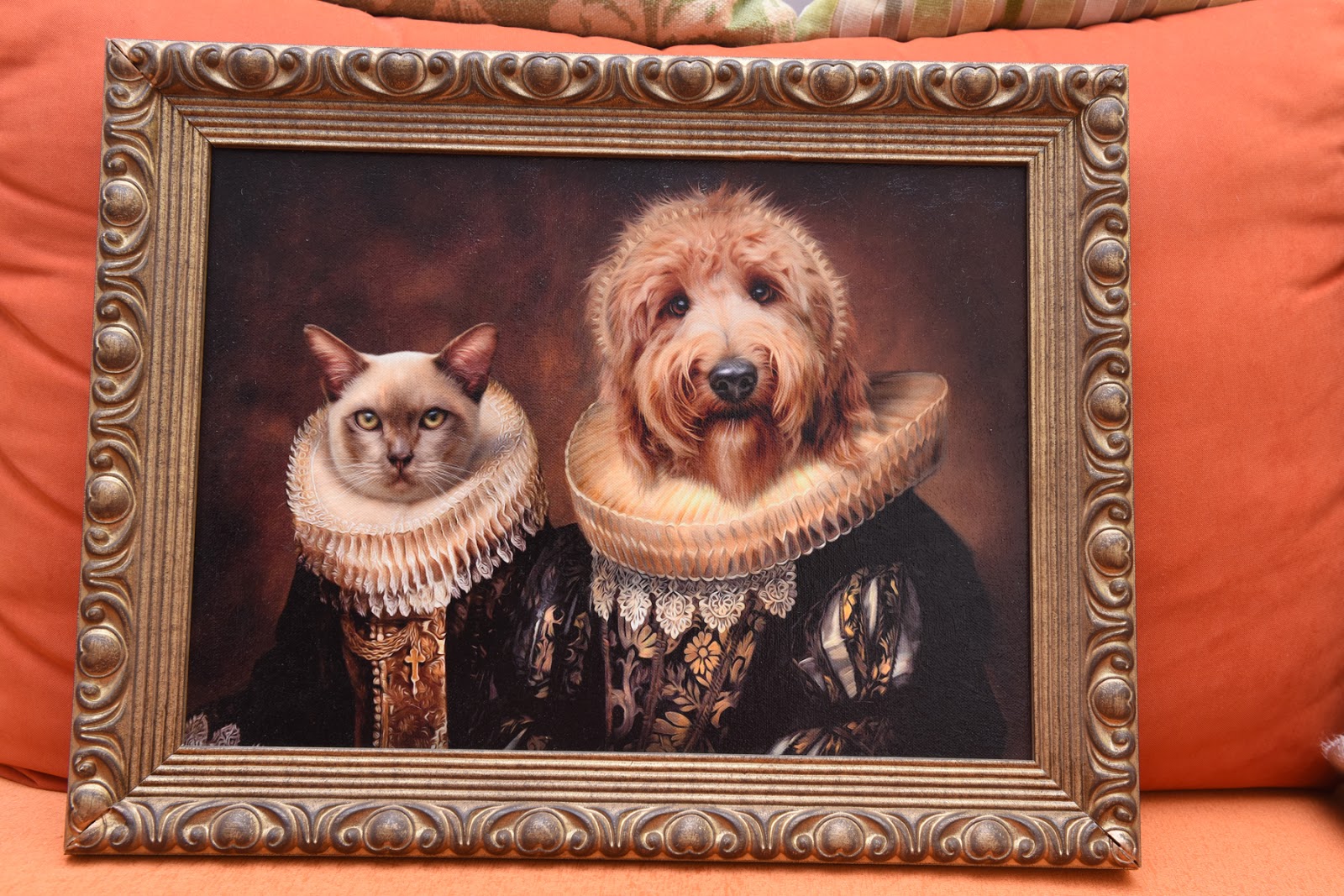
What is the ideal gift for a busy veterinarian? We recently asked this question in planning for a milestone birthday (21) for our boss. The answer was an historic painting featuring her non-human family members from Paul Carpenter at Pompous Pets.

Geoffery, captured in a rare nanosecond of stillness.
We submitted photos of Geoffery (Burmese) and Ellie-May (Labradoodle) and along with a brief biography of each. Geoffery is definitely in charge. Paul sent us a draft, we agreed that it looked awesome, and he hand delivered it.

This is the final result – and yes, she did love it!

Geoffery and Ellie-May, painted by Paul Carpenter.
Also this week, I was interviewed by Brian from VetTalkTV about Monday’s blog post. You can listen to the podcast here. 

Thursday, December 11, 2014

Call for Pet Santa Photos

Sanchez in his Santa hat. Which he wore for three seconds in exchange for a parsley bribe.

Yesterday we interviewed Nick Baldas, the artist behind the exhibition My Human Family Rescue Dogs Find a Home. Today we’re helping them out by calling animal lovers to submit their pet Christmas photos and help spread the word about rescue pets.

I hope this little dude gets his Elizabethan collar off before Christmas.
If you have a photo of your pet looking festive, you can email them to myhumanfamily@hotmail.com so they can go up on the My Human Family facebook wall.