Showing posts with label pets and aged care. Show all posts

Friday, March 24, 2017

Ideas needed: how can we improve pet accessibility in Australia?

dog waiting,
What if you could take your dog with you?
Have you ever wanted to take your pet somewhere, but couldn’t? What if you had to go to hospital for a medium to long-term stay? I meet many people who delay elective surgery because they do not want to be separated from their closest companion – a non-human animal. For many of my older clients, their companion animal is everything to them, they're reason for waking up, for getting out of the house, for maintaining a routine. This is such an important bond. If they can't take their pet to a particular place, they don't necessarily want to go.

There are groups of people who are keen to improve animal accessibility in Australia, and some of these are getting together in Canberra next month to brainstorm.

If you can get to Canberra next month (on April 26), Pets andPositive Aging are hosting an event looking at what is happening in other countries that have better pet access, and what could be done here. Of course, there is a focus on responsible pet ownership. Your ideas are very welcome.

Chaired by Mary Porter AM, speakers are Meegan Fitzharris MLA Minister for Territory and City Services and Minister for Health; Tammy Ven Dange, CEO RSPCA ACT; Jan Phillips, President of Pets and Positive Ageing Inc; Kate Cvetanovski, Execeutive Director of Northside Community Service; Dr Alison Taylor, veterinarian, 2016 ACT finalist for Australian of the Year and the Manager of Domestic Animal Services. The full program is available hereThis event is generously supported by Northside Community Service.

Attendance is free but places are limited and bookings are essential. Book here. If you do have any burning ideas you're willing to share but can't make it, contact Pets and Positive Aging directly or drop us a line and we will forward your email.

Sunday, February 12, 2017

Help people age positively with pets

When we know the companionship that animals provide, and the loving homes aged owners can provide, shouldn't we work hard to preserve those relationships?

Can you imagine a life without animals? Most of us don’t have to, until we get older and the prospect of having to give up companion animals to move into aged care accommodation looms large. Some people may be able to continue living at home, but have to give up their companions due to an inability to care for them (e.g. provide regular walks).

A Canberra-based advocacy group, Pets And Positive Aging (PAPA), is campaigning to ensure that pet support becomes of the standard services offered to persons in home and community care. This might involve helping companion animal owners meet their animal’s needs, for example regular exercise.

It’s likely that most people reading this blog are fairly convinced of the benefits – to humans and animals – of responsible pet ownership. But for many organisations, assisting people with companion animals sits in the “too hard” basket.

You can assist PAPA by reading and sharing this article.

You can also visit their website here.


Other ways to assist include talking to your local home and community aged care organisations about assisting companion animal owners. 

Friday, April 15, 2016

How can we help support older people with companion animals?

Can we do more to support the bond between companion animals and senior pet owners?

A few years ago I did a house call to vaccinate an overweight Maltese terrier. The owner was 96 years old, lived home alone, and was estranged from her family. She told me that the only reason for getting out of bed in the morning was to feed her dog. Her biggest anxiety? Going to hospital or into care and having to part with her dog.

“That would be the end of me,” she said.

As Julia Keady blogged,

Next time you're at an animal shelter, take a look at the number of senior dogs lined up in pens wondering what happened to their lovely warm home. Then think of their owners, many of whom have moved to nursing homes, missing the beloved canine or feline they couldn't bring with them.Then consider the separation anxiety of two souls who had perhaps long been each other's companion, source of joy and a big reason to get out of bed in the morning, and you are starting to understand a very real and psychologically tormenting issue that our ageing population faces.
This is a real and very painful issue affecting many Australians.

It’s undeniable that we treat older people in our community differently. Rather than venerating our elders, they are often treated as a burden – financial, emotional or time-wise. I don’t know why this is – I’ve got plenty of friends and family who have seven or eight decades under their belt, and they’ve got the best stories. They've usually seen it all, done it all, and don't catastrophise about it the way younger generations do. But they can also be very lonely.

Animals don’t discriminate based on age. In fact, an older person is more likely to enjoy a quiet night in, and plenty of dogs and cats appreciate a human hot water bottle to sit with or on. They are incredibly important companions, they’re a talking point, someone to talk to, a reason to stick to a healthy routine, an adjunct to the doorbell (some more than others!) and so on.

Furthermore, many senior pet owners have senior pets – those who are less likely to be re-homed if surrendered to a shelter or pound.

It’s true that the companion animals of older people may need more support – maybe its walking, help with trips to the vet or assistance with medicating – but if they can be well taken care of in a safe environment, it can be beneficial for all parties to support that human animal bond.

Keady interviewed, among others, Di Johnstone, someone who has been a consistent and very powerful advocate for the need to recognise and support the bond between senior pet owners and pets. She has been involved with Pets and Positive Aging as well as the Pets and Aged Care Steering Group.

According to Di Johnstone, we can all help by:
  • Talking to aged-care providers and community service organisations about the benefits of the human animal bond to older pet owners;
  • Encouraged aged-care providers and community service organisations to offer pet-friendly accommodation and care;
  • Promote aged-care providers and community service organisations who do provide support for older pet owners;
  • Volunteer for or set up a community based in-home support service for older pet owners.


If you want to read more about Di’s work, and about this issue in general, check out our previous post here. Thanks to Claire for suggesting this topic!

Monday, July 7, 2014

Supporting older owners through bereavement following pet loss

Pets with older people need support, and may need even more support when it comes to pet loss.
Older people with pets need support.

One of the most common and tragic reasons that older people decide not to get a pet is that the grief of losing a pet can be overwhelming. Sometimes when people lose a pet they say to me “I will never get another animal, it’s too heartbreaking”. That breaks my heart because usually these people are the most caring, wonderful owners – but I do understand that losing an animal can be extremely painful.

Earlier this year I was fortunate enough to meet Adele Mapperson, the chaplain at the Lort Smith Animal Hospital (you can read about her services here). Adele is an incredible person, her role is a very important acknowledgement by the Lort Smith of how important support is around animal loss. The support is offered to everyone and is not denominational.

I met Adele briefly and interviewed her for The Veterinarian Magazine, after which I started researching the topic in more depth. Veterinarians witness a lot of grief, but it may only be the tip of the iceberg.

A US study involving 177 clients across 14 practices found that 30 per cent of pet owners experienced severe grief around the loss of their pet, with reactions characterised by insomnia, loss of appetite and “feeling like something died within them” (Adams et al 2000). That grief remained fairly consistent for around 6 weeks after the death of a pet.

Another study of 106 owners from a single veterinary clinic found that subclinical levels of grief and sadness lasted for six months or more in 30 per cent of people following the loss of a pet (Adrian et al 2009).

For older people the feelings may hit harder for a number of reasons, including loss of companionship and a percieved loss of social support around pet care (for example, the people you meet when you walk your dog, the groomers and vets you may chat to).

Veterinarian, lecturer, intern mentor-scheme director and pet bereavement counsellor David Foote will be giving a lecture on “Supporting older pet owners through pet bereavement” on 5 November 2014 at the ACT Legislative Assembly. The session will be hosted by the Patron of Pets and Positive Aging Inc, Mary Porter AM MLA.

The session will run from 10am to 1pm at the Reception Room of the Legislative Assembly Building in the Civic Square in Canberra. Please RSVP by 30 October 2014 to dijohnstone@bigpond.com

There will be plenty of opportunity for questions and answers as well as an introduction and closing session by the wonderful Jan Phillips, President of Pets and Positive Aging Inc. In the meantime, its a good reminder to offer support to anyone you know who has lost a pet. A thoughtful card, a cup of tea, a call to check in - something to acknowledge their loss and let them know you are there can make a lot of difference.

PS you can read about the great work done by Di Johnstone here and Jan Phillips here.

References

Adams CL, Bonnett BN & Meek AH (2000) Predictors of owner response to companion animal death in 177 clients from 14 practices in Ontario. Journal of the American Veterinary Medical Association 217(9):1303-1309.


Adrian JAL, Deliramich AN & Fruch BC (2009) Complicated grief and posttraumatic stress disorder in humans’ response to the death of pets/animals. Bulletin of the Menninger Clinic 73(3):176-187).

Monday, January 20, 2014

Helping older people keep their pets: interview with Karen Schlieper

Karen with the late Pokemon aka Pokey, a rescued Spitz cross. Karen reared him from the age of four weeks and couldn't bear to part with him when he was old enough to be adopted. So he moved in and lived for 13 wonderful years.

Karen Schlieper has been working at the RSPCA since I can remember, she has a soft spot for animals and she is particularly passionate about helping older people maintain the bond with their pets. She took time out of her busy schedule to chat to SAT about what she does and how she finds the energy to do it.

Tell us a bit about yourself – who are you, what do you do?
I have been with RSPCA NSW for close to 30 years. I started off as an Animal Attendant, have worked in all areas of the Yagoona shelter as well as several regional shelters throughout NSW and also some time at Darwin, NT shelter. I have also worked within the clinic, finance, payroll and workers compensation areas so have a broad knowledge of RSPCA operations. I now work with the 4 clinics (Sydney, Rutherford, Tighes Hill & Broken Hill) and Community Outreach Programs. RSPCA NSW runs several programs to assist people and their pets including the Community Animal Welfare Scheme (CAWS), Indigenous Dogs, Living Ruff, Pets Of Older Persons(POOPs) and Safe Beds For Pets.

Pets & people are incredibly important to me and it gives me great satisfaction to be able to assist people with their pets.

POOPs is the RSPCA program I started with and I am also on the ACT Steering group which is aimed at promoting the government to assist with Home Care etc that includes pets so people can stay in their own homes longer. There is also another group that I have regular contact with, RealAnimals, Pets and People, they are based in Victoria and this is made up of a whole lot of small community groups that assist mainly elderly or financially compromised people with pets in their own homes.

Do you have any pets at the moment? Can you tell us a bit about them?

I have 3 dogs and 3 cats, all from the RSPCA. My dogs are: “Pixie” a Cavalier Spaniel x who is now 11yrs old. “Angel” a Tibetan Spaniel x who is 12yrs old and “Pookie” a Pomeranian, 4yrs old (the newest recruit, adopted in May 2013). The cats are: “Bumble” Domestic Shorthair, 12yrs old, “Jamaica” Exotic Shorthair, 12yrs old and “Poppy Buttonfield” Persian, 4yrs old. I grew up with animals, dogs, cats and birds and have since had fish and a goat and cannot imagine not having any!
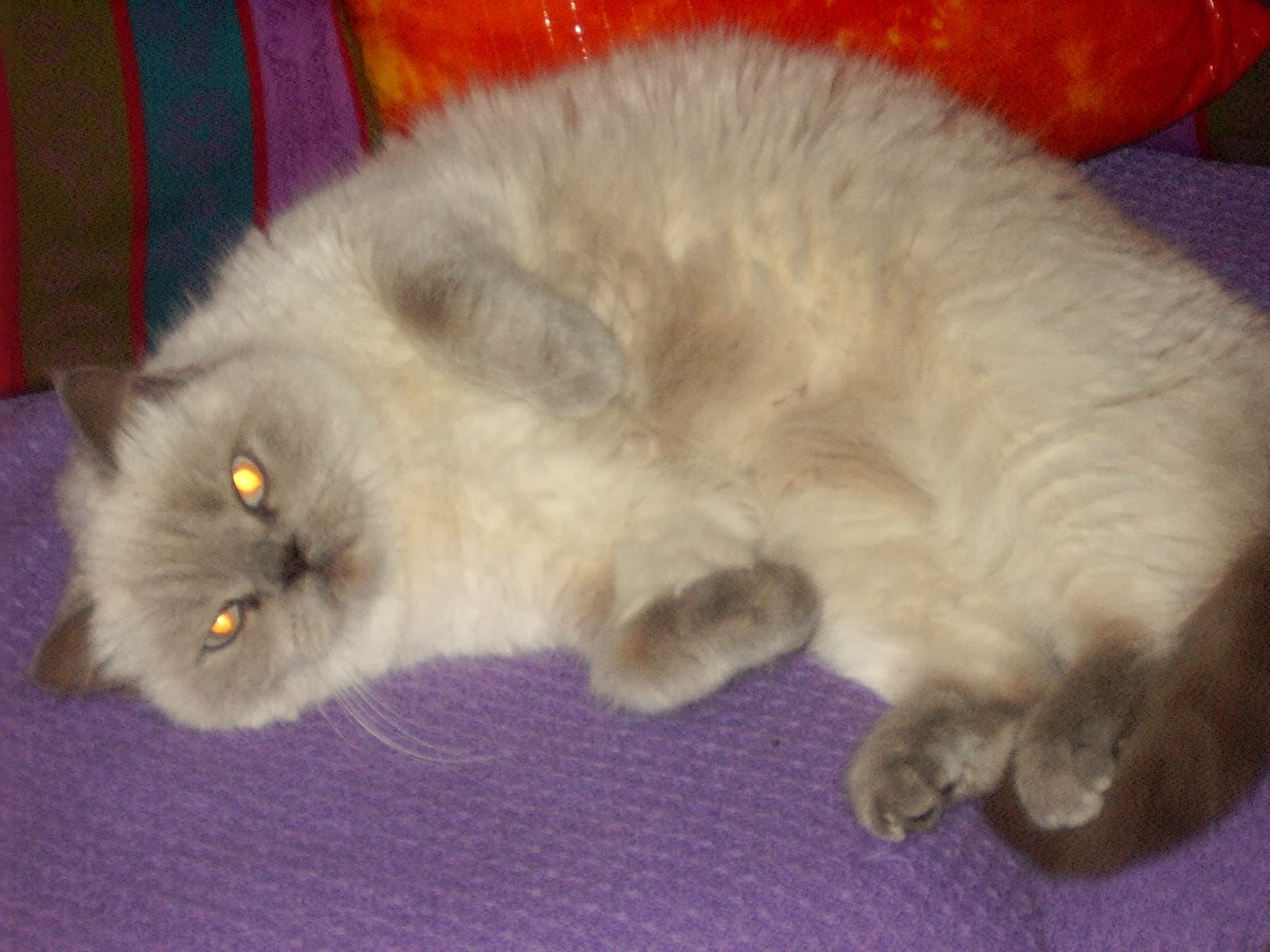
Jamaica.
Angel.
How important are your pets to you?

My ‘kids’ are incredibly important. My partner and I have had numerous between us and I could not imagine a life that didn’t include a companion animal. They live with us, sleep in their beds in our room, sit on the lounge, play, exercise and generally fit into all aspects of our lives. They are the comic relief and joy in our lives and although when the time comes and they pass away it is terribly distressing I am incredibly thankful for the love and joy they bring while they are with us.

Pixie catches some z's.
How did you become interested in the area of helping older people with their pets?

I have always been a social person who enjoys talking to others about their pets and hearing stories about their life in general. Being able to interact and assist other people to do the best for their pets has always been a passion and I grew up with my grandmother and nana as next door neighbours so had lots of contact with older people and enjoy their company. Work now gives me the opportunity to combine things that I love to do!

Can you tell us a bit about the bond that older pet owners have with their pets?

Older people, particularly those that live alone, depend on their pet for love and companionship. It gives them a focus and a common expression I hear is “I wouldn’t even get out of bed if it wasn’t for...” Pets give a sense of purpose and make people feel they are worthwhile. Your pet is never going to criticise you or give you a hard time about your cooking, your looks or anything else. Pets are completely accepting and devoted to their people and will protect and love you. For an older person (and not just the older population!) this is often the only regular companionship they have and the human/animal bond is incredibly strong.

Bumble gets up close and personal with the camera.
How does POOPs work, and how does it benefit humans and animals?

POOPs assists elderly pet owners with care of their pets and also allows them to take care of their own needs. We have lots of clients that delay dealing with their own health issues because they have no one to look after their companions. POOPs aims to assist older pet owners to stay in their own home for as long as possible, we work with human services to ensure a holistic approach to both people and animal care. We provide regular in-home services to ensure parasite control, monthly flea control, intestinal worming etc. as well as grooming and bathing of pets for people who may have difficulty in doing so themselves. We also provide boarding or foster care for pets if the person needs to go into hospital or respite. They can then concentrate on their own health without having to worry about their pet who will be very excited to see them when they come home again!

Pookie.
Why is it important to keep people in their homes longer?

With an ageing population there is more strain being put on health and aged care services. There is limited availability in nursing homes (and they are not everyone’s choice of accommodation) and quite a number of these are not animal friendly which means that people have to give up a loved companion – devastating for both the person and the pet! If people are supported to stay in their own homes then they are in familiar surroundings and are able to continue to live in a manner to which they are accustomed and also content. If these people had to go into care facilities they would have to make a choice about their companion animal too and unfortunately these are generally quite limited – surrender to a shelter or rescue group, rehoming or euthanasia. By supporting people in their own homes we can also reduce the number animals that end up in these situations.

How can other members of the community support older pet owners?

Take the time to check! If you know of an elderly pet owner it can be as simple as talking to them. Sometimes they are socially isolated and the only company they have is their pet and the offer of a chat or to assist with walking a dog or even to give them a lift to a local vet would be very much appreciated. POOPs has volunteers and foster carers that assist with these sorts of tasks (see RSPCA NSW website). Also donating things like old blankets, food, heated pet beds, dog coats, flea treatments, shampoos etc and monetary donations to POOPs helps us to provide ongoing services to our clients. If you see someone that you think needs help, offer it, they may not need it but will very likely appreciate that you have asked. If you don’t feel able to do so, contact POOPs and we can send out some brochures, you can pop one in a letterbox and maybe we can help.

Poppy the persian.
How can veterinarians and vet students support older pet owners?


Vets and vet students can help by providing guidance and assistance to older pet owners. If possible discounted vet treatment will help ease a financial burden as these clients are generally living on a pension and although they want to be able to provide the best for their pet, financial constraints sometimes prevent this from happening. Even the ability to pay off an account or setup a ‘savings’ acct with a local vet will give peace of mind to a client. We have clients that have $5 from each pension put into a ‘savings’ account for their pet so that when annual checks etc come up they don’t have the worry of paying a bulk amount at once. There are also opportunities for vets and vet students to attend events like Million Paws Walk, Northcott Pet Day and Pets in the Park. Some of these are targeted at those pet owners that may be doing it tough and help both the animal and the owner with their health and welfare.

Thursday, November 14, 2013

Designing pet-friendly accommodation for the aged & are birds capable of altruistic behaviour & pet loss

Footprints and pawprints in the sand (even though it does appear that the person walking has two left feet!!!).
Getting old is inevitable, but getting old without the company of your companion animals - or having to part with them to move into a retirement village, aged care facility or nursing home - is downright awful.

The Pets and Aged Care Steering Group (chaired by the wonderful Jan Phillips and Di Johnstone) ran a fantastic workshop on designing pet-friendly aged care. You can download and read the papers by clicking here including the case for pet friendly planning of aged-care accommodation, design considerations and a veterinarian's perspective.

If you think you might ever need aged care (and I daresay that most of us will), you should be acting on this now to ensure that appropriate pet-friendly accommodation is available.

On another note, Alex the Parrot used to say "I love you". What did he mean? One theory is that he was simply seeking a reward and he realised that this combination of words led to exactly that being produced. I'm not so sure we can draw this conclusion.


Are magpies capable of altruistic behaviour?
SAT reader Ro sent this fascinating link discussing the explanation behind a scenario involving two magpies. If you take an anthropomorphic position you might just think that one of these magpies is helping the other seek treatment for an injury. But if you take a behaviourist approach it could be just a sophisticated way of seeking a food reward. My personal take is we don't know enough to conclude either way, but in this scenario the anthropomorphic stance works better. What do you think?

Finally, Do You Believe in Dog Blogger Mia Cobb wrote this beautiful post about the death of her dog Elke. Elke was rescued in a cruelty investigation by the RSPCA as a puppy. Though life started out rough, she was adopted by the Cobb Mob and shared her life with a loving family who wanted to give her positive experiences (Mia has provided some gorgeous photos). Mia discusses her own grief but also the human animal bond and grief in general, as well as sharing some resources for those who want to read further. 

Friday, October 4, 2013

Seminar for pet owners and the Pets for Life Program

(c) Anne Fawcett
Puppy delivered by caesarian section snuggles with brothers and sisters.
These items aren't related but I wanted to get them out there asap. If you're a pet owner interested in learning more about socialisation of puppies, canine behaviour and preventing cancer in pets, the Animal Referral Hospital is hosting a seminar just for you on Saturday November 9.

Oncology nurse Tanja Richardson will talk about causes and prevention of cancer in dogs while Behavioural Specialist Dr Kersti Seksel will cover dog developmental stages and puppy socialisation. A hospital tour will be offered afterwards. It costs $25. RSVP by emailing seminar@arhvets.com.

Di Johnstone, secretary of the Pets and Aged Care Steering Group, alerted me to a media report about the Pets for Life Program run through Caloundra Community Centre, Inc. The program, a service available free to local senior citizens, pairs up volunteers with senior pet owners. The volunteers help owners out by walking dogs and helping with pet related tasks (visiting the vet or groomer).

Volunteers help reduce the number of pets surrendered - and the number of old people parted from their pets - by allowing the pet to stay with that owner.

(c) Anne Fawcett
Volunteering to walk and take someone else's dogs to the vet can make all the difference, allowing an elderly or unwell person keep their pet when the alternative is surrender. That helps reduce the number of animals in shelters and it promotes a healthy human-animal bond.
That is the sort of program that every local council should be establishing. It isn't just animals who stand to benefit - Pets for Life reduces social isolation of senior citizens.

(And the issue could prove important during local elections. A survey of Noosa and surrounds residents found that 97 per cent believed the elderly should be able to keep their pets when they go into retirement homes).

You can read more about pets and aged care here and here.

Saturday, August 31, 2013

"They're our kids" - Pets in a retirement village

As we get older, we need our companions more. And as they get older, they need us more. We have the resources to support the human animal bond, so we need to make it happen.
SAT’s interview of Di Johnstone, of the Pets and Aged Care Steering Group, is one of our most popular posts ever – as it should be. Many people who have to make the choice to live in a retirement or nursing home are forced to give up their pets. And yet these are the people who need their companion animals most. 

You can read the full interview with Di here:


Meantime, she’s sent some more resources on the topic, including this excellent ABC interview by Sharon Molloy with residents at the Oak Tree Retirement Village in Cairns, and Tricia Miles, Convener of the Cairns Pets and Aged Care Discussion Group.

According to Miles, many retirees simply aren’t aware that some aged care facilities allow pets.

“People seem to believe that it is legislation that prevents aged care facilities from actually taking pets in…that is apparently not true, it is more fear of litigation.”

Pour yourself a cuppa and listen to the full interview here: http://www.abc.net.au/local/stories/2013/08/21/3830490.htm?site=farnorth

Pets get older too. The American Veterinary Medical Association have provided some guidelines on senior pets via this link. A recent study found that older dogs depend on us more - as they age they are less able to cope with emotional social distress. Just as we need them, they need us more. You can read more here.

SAT would love to hear from anyone who has been able to negotiate accommodation in a pet friendly retirement village, nursing home or special needs facility. Please drop us a line.