Showing posts with label wildlife. Show all posts

Friday, July 28, 2017

Wildlife forensics in Sydney

Koala
Wildlife crimes should be investigated. But what evidence is collected, and what can it tell us?

How do we solve wildlife crime? First it depends on collecting the evidence. Wildlife forensics is a field that has, unfortunately, had to grow due to a sharp increase in wildlife crime including poaching.

New Scientist and the University of NSW are hosting a joint session on Wildlife Forensics at UNSW on August 17 in Sydney.

The speakers are Bryan Lessard – aka Bry the Fly Guy – postdoctoral fellow at the Australian National Insect Collection, CSIRO, and Rebecca Johnson, director of the Australian Museum Research Institute and co-chief investigator of the Koala Genome Consortium. For more info or tickets, click here.


Monday, June 26, 2017

Small changes, and other things I learned about Dr Jane Goodall

Dr Jane Goodall wants to see chimpanzees in protected natural habitat - not confined in baron captive environments.

Are you familiar with the work of Dr Jane Goodall? I was fortunate enough to see her public lecture in Sydney last week. Famous for her study of the chimpanzees in the Gombe Stream National Park – particularly the discovery that chimpanzees not only use but make tools – she has become an outspoken conservationist, travelling 300 days a year (even at the age of 84) to try to turn back the clock on species extinction.

She stood and spoke articulately and passionately for an hour, without any notes or cues, with the manner of Obi Wan Kenobi, about her early life and how attending a conference session in the 1980s on habitat destruction and species loss turned her into the activist she is today. Ironically she spent a lot of her early career battling the stigma (at least among her scientific peers) of being a leggy Nat Geo covergirl, but I got the impression that this in some ways spurred her to work even harder. So here are a few things I learned about "Jane".

She didn’t do it alone. When Jane was featured on the cover of National Geographic magazine in the 1960s it seemed that she was a gorgeous, jungle-dwelling solo scientist living only in the company of her study subjects (chimpanzees). In fact because of various restrictions she wasn’t allowed to go into the jungle alone initially, and furthermore had to be accompanied by not just anyone but a European. So her mum Vanne upped and went to the jungle. While Jane was climbing peaks and watching chimps all day, her mum was in the camp – surrounded by creatures who could be dangerous, coaxing snakes out of the tent and even contracting malaria from which she almost died. Jane’s mum lived well into her 90s. When her mum left Africa, Jane soon met and married a National Geographic photographer who helped her set up a research station.

She got her PhD before she got her undergraduate degree. Her boss, Dr Louis Leakey, talked to colleagues in Cambridge and recommended her, and Jane managed to complete her PhD. Over the years she certainly did do the equivalent work for both the undergrad and postgrad qualifications, but not in the order we’re used to. In her book Reasonsfor Hope, she talks about why it was beneficial for her to study chimpanzees without a formal scientific education first. I’m sure some scientists will disagree, but it’s an interesting argument.

She counters her despair about the planet, the complex issues of habitat loss and fragmentation, anthropogenic climate change, species extinction and environmental degradation by encouraging people to make very small changes in their lives. Not necessarily trying to change the world, but understanding that every little action taken – every plastic bag refused, every item recycled, every meatless meal, every nature strip reinvigorated, counts. (For example, you could make a difference by choosing to refuse single-use plastic in July and beyond – find out more here: http://www.plasticfreejuly.org/). Though Jane does a bit more than just act locally. In 1977 she founded the Jane Goodall Institute which among other things runs conservation projects around the world. But during her talk she was most excited about her Roots and Shoots program (founded in 1991), designed to teach and get young people involved in conservation.

You can even enroll in a free online course for educators, taught by Dr Goodall and colleagues. More info available on the Roots and Shoots website.

If she weren’t trying to convince people to act to save the planet, Dr Goodall assured the crowd that really she’s an introvert: she’d prefer to be home, in the house she grew up in, or “alone in a forest”.

You can read more about her work here.


Friday, September 9, 2016

How do you help a baby bird?

This flow-chart is courtesy of wires.org.au

What do you do when you come across a baby bird in distress? Thousands of well-intended people bring young birds found on the ground to veterinary hospitals and clinics. The problem here is that it is almost impossible for us to reunite birds with their parents.

According to WIRES, for many common bird species in Australia, “chicks go through a growth stage where they spend time on the ground.”

They should be left in the care of their parents wherever possible. It’s better to follow the steps outlined above.

In other news, Arizona Veterinarian Deberah Butler freed a distressed Elk that wandered into her yard after becoming entangled in a swing, bringing new meaning to the term “home visit” (and it wasn’t a quick appointment!) You can read about it here.

For those who can’t get enough of Vitamin N (nature), We Are Explorers wrote this post about NSW-based adventures to have with your dog.

And for anyone who wants to learn more about how humans and dogs communicate, check out this Catalyst episode, the first of a two-part series, on dogmanship.


Thank you to those of you who continue to contribute to The Vet Cook Book. If you’re thinking about it but need some encouragement, or wish to contribute in a way other than providing a recipe, drop us a line: vetcookbook [at] gmail.com We will be sharing some more recipes soon. Why would you want to be part of this? Its fun. Its delicious. You can make something and eat the results. Its an excuse to get together with people. Its a good chance to share a positive story or some great advice. It's going to be amazeballs.

Monday, February 22, 2016

Did selfies kill the dolphin?

elephant wildlife ride cruelty
Photo opportunities with wildlife have been thrust into the spotlight following the alleged death of a dolphin.


It is alleged that the Fransiscana dolphin died of dehydration, heat stress or a combination when it was manhandled after being washed up (along with at least one other dolphin) on a beach in Argentina, although there are now claims that the dolphin was deceased when the alleged selfies were taken.

The truth is we don’t know the cause of death. It may have been that the dolphin came ashore because of pre-existing pathology – regardless, if you’re in a critical condition, being over-handled and subjected to stress is going to exacerbate stress. Let's entertain the hypothesis that the dolphin was killed by selfies for a moment.

It is absolutely understandable for people to be curious about animals, but this - if true - is a tragic example of people’s compassion and curiosity causing unintended suffering. The internet was full of moral outrage and disgust at humanity, but it’s likely that the people participating had no clue that they were being cruel, and probably identified as animal lovers. How can this be? 

We’re not taught to consider the situation from the animal’s perspective.

As Professor John Webster teaches, animal welfare is about two things: our perceptions relating to our treatment of animals, and THEIR perceptions of their own state. And these things are not necessarily the same.

Even science and veterinary students are warned of the dangers of unchecked anthropomorphism - which can make them feel uneasy about empathising with animals at all.

But if we consider what this experience was like for a small animal, without language and without any sense of when the handling would end, we start to get an idea that our curiosity, enthusiasm and affection for animals can look very different from their point of view.

The dolphin example is abhorrent to people because the suffering of the animal was acute, but many photo opportunities are associated with insidious, chronic suffering.

It is not the first time “selfies” have been implicated in animal harm. According to this report, black cats have been abandoned in droves, and others not adopted, because their features don’t show up as well in photos.

There’s also the wildlife tourism trade. I’ll admit I’ve been guilty of posing with a wild animal for a photo, unaware that the animal has probably been captured for that very purpose. Some years ago a friend and I travelled together and rode elephants and had our photos taken with lions and tigers. I asked keepers about the welfare of the animals and allowed myself to be convinced – but the queue of tourists in line waiting for a photo behind me told a different story.

When I came home some online research revealed that the places I’d visited were known for using techniques designed to “crush the spirit” of elephants.

The good news is that awareness of such welfare unfriendly practices is spreading.

World Animal Protection just teamed up with Oxford University’s Wildlife Conservation Research Unit to release its report, Checking Out of Cruelty. They found that globally, more than 550,000 animals are suffering through irresponsible tourist attractions. Welfare and conservation abuses are happening in 75% of tourist attractions included in the study, with some of the worst venues being elephant, bear and tiger parks, and a turtle farm.

Yet when they looked at reviews on Trip Advisor, 80 per cent of tourists left positive reviews – even though some observed that they had concerns about animal welfare. Some of these facilities even received a Trip Advisor “Certificate of Excellence” based on these reviews. Up to 4 million tourists per annum visit the attractions assessed in the study. The authors predict that up to 110 million people worldwide visit cruel attractions globally.

It isn’t because people don’t care. “We know that when people are told about the cruelty behind such activities, most decide not to go,” the report says. 

Cruelty may involve the animals being “broken in”, punishment, being kept in poor conditions (for example, chained up in an enclosure with concrete floors), barren cages, poor nutrition (for example caged civets are made to eat an unbalanced diet of coffee beans), body modification (for example, de-fanging venomous snakes) and the stress of handling. Apart from the latter, most of this happens behind-the-scenes. 

So how do you know? According to the report, an authentic wildlife tourism experiences will not allow contact or interactions between wild animals and tourists.

It suggests avoiding
  • Riding wild animals
  • Swimming with captive wild animals
  • Petting, holding or hugging wild animals
  • Washing wild animals
  • Keeping wild animals on a chain or leash
  • Watching wild animals dance, play sport, perform tricks, give massages or paint pictures

In short, “If you can ride it, hug it, or have a selfie with the wild animal, the chances are it’s a cruel venue. Don’t go.”


You can download the report here.

Friday, February 19, 2016

Helping vets and rhinos: interview with Dr Helen Jones


Dr Helen Jones on safari.
Dr Helen Jones is best known to Australian veterinarians for her research on occupational health and safety in veterinarians. She’s now on a mission to save rhinos.

I met Dr Jones through the Australian Veterinary Association’s wellness stand at the annual conference. I didn’t know then that she was the first woman to be elected president of the Australian Veterinary Association in 1982. Among other things she was Associate Professor in Public Health at Curtain University. In 2014 she was awarded the AVA's Presidents Award for her contributions to the profession. She's also an avid volunteer.

Dr Jones has a career history of service, so it’s not surprising she’s lending her support to a species in need. She talked to us about her interests in the wellbeing of veterinarians and why rhinos need our support.

Can you tell us a bit about your current work?

My PhD research was on injury, zoonotic diseases and stress that vets experience. I discovered that suicide was a major problem, certainly in Victoria and WA. I have continued to work with the team involved with suicide prevention mainly Brian McErlean here in Perth.  We run the Wellness Centre at the annual AVA Conference with an emphasis on mental wellbeing (and thus suicide prevention).  To encourage vets to come into the Wellness Centre, I have arranged for a fitness company to come in and do wellness checks on vets and exhibitors including blood glucose, cholesterol, heart rate and blood pressure. [Ed: I’ve had it done. Note to self – eat the jelly beans AFTER the blood glucose test this year].

A few years prior to my retirement from Curtin University in 2010, I became involved with the SAVE Foundation (Save the Black Rhino Foundation). The Foundation works almost exclusively in Zimbabwe. We have expanded its title to SAVE the African Rhino (SARF) because we also help out in South Africa, Namibia etc.  I first went on safari in 2010 where I learnt a lot about the SAVE Foundation and its work.   

Why do you do all this?

Difficult to answer why I do it.  I guess I am just committed to volunteering for great causes.   Veterinarian well-being is the most important and then the rhinos.  I am also heavily involved in Rotary.   I ran a Rotary Club of Canning Bridge Arts and Craft Market once a month for two years.  I am now the Secretary of my local Rotary Club.

I have visited the Zimbabwe Veterinary School in Harare several times now. The first impression in 2009 was that it was poverty struck.  No journals from 1990 and no access to computers.  Their laboratory equipment was all broken.  I tried to help them with donations of books and to get a container of secondhand vet equipment over there. That wasn’t successful but we took over a few books and I worked to get them access to journals and on-line databases.  They have since gained a few computers that allow them to access the databases in the library.  Initially they were being banned from accessing these because of an international boycott.

Second-hand gear can mean the world of difference for vets working in areas of need.
I have helped some vets at the vet school get articles published in journals.

We support some of the vets there with their dehorning programs for rhinos and with helping procure Suprelorin from Peptech (now Virbac) for “sterilizing” lions to prevent them from breeding.
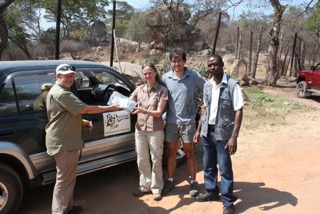
Dr Jones hands over the supreloren.
I have brought as luggage an anaesthetic machine and three microscopes and a couple of centrifuges (not all at once!).   Some vets have donated medicines.

I also lobbied DFAT and written letters of support to help veterinarians in Victoria Falls receive a $30,000 Australian Government grant to build wildlife and veterinary facilities just out of Victoria Falls.

To raise money for the SARF Activities, we hold an annual auction of sporting memorabilia that last year raised close to $200,000, plus SARF run safaris which raise about $100,000 per year. All told, SARF (previously SAVE) has donated over $6 million (up to $500,000 per year) to activities to primarily help save the rhinos from poaching.  This involves paying to train the rangers, providing them with uniforms, boots etc, camera traps, tracking devices and vehicles (we probably have about 30 vehicles in Zimbabwe.  We also contribute to cost of the dehorning operations (involves hiring planes, helicopters, ground crew for horn removal). It costs about $1500 per each dehorning.

How did you become interested in rhinoceros conservation?

The rhino numbers are declining. South Africa, especially Kruger National Park, has a high rate of poaching with over 1000 rhinos poached for their horn in 2014. The rate declined slightly last year (still above 1000) but the rate in other African countries has risen (including Zimbabwe).

Why do rhinos need our help?

Poaching is rife because of the demand from Vietnam and China for rhino horn.  The current black market price is $60,000- $70,000 per kilo. A big male probably has a horn around 4 to 5 kilos.  By the way the local wage paid in Zimbabwe is US$100-$200/month so getting involved in poaching is very tempting.

There is a campaign run by a Melbourne based company called Breaking the Brand and it is focussed on Vietnam to try to stop the demand [for rhino horn] from growing middle class there.  Rhino horn’s alleged purpose is no longer about curing cancer, but is given as an exclusive gift to the rich.  I would prefer our efforts to go into this campaign.  In the meantime, each safari raises several thousand dollars for SARF.

How can vets help rhinos?

Vets can come on safari to see the people we are supporting. It is not all hard work.  Vets and their friends see wonderful wildlife including many birds.   The cost of the safari is relatively high but all the money goes towards SARF. I pay my own way.


If you are interested in going on safari with Dr Jones from August 22 to September 5, you can check out the program here.

Monday, October 12, 2015

Animal-related word of the day: "poophoria"; a free course on canine cognition and emotion and why we need to lift our game on the plastic bag front

Feline litter tray habits can be mysterious. Why do cats run away from their own stool? Is it fear of something foreign? Or are they celebrating? The experts reckon they have the answer.

Does this sound familiar? You’re minding your own business when you hear some digging around in a litter tray somewhere not too far away. Then, silence. Then frantic scratching around in the tray. And BOOM. Your cat explodes trhough the door, racing past you at Road-Runner speed, and you know immediately that they’ve deposited something solid in the tray. 

I won’t embarrass anyone by naming names, but one feline member of my household does this daily. 

What is the explanation for this sudden, dramatic and sometimes alarming behavioural change? Science has failed to deliver an answer, probably in this case because no one has been particularly interested in investigating. But the internet abhors a vacuum.

A recent article on thedodo.com quotes Erin Willis, an animal physiologist, speculating that cats may be experiencing “poophoria”. This on the basis of a gastroenterologist who suggests that in humans, defecation may stimulate the vagus nerve which may lead to – among other feelings – a feeling of exhilaration. You can read it here.

It’s hardly data that would convince practitioners of evidence based medicine, but it’s a fabulous – perhaps even craptacular - portmanteau word. 

And the online discussion did get me wondering, how might you design an experiment that would yield a reliable explanation? Would you compare the post-toileting behaviour of domestic and wild cats? What variables would you want to control for (diet? Litter type? Number of cats in the household?) And who would fund the research?

In other news, online education provider Coursera is offering a free course on Dog Cognition and Emotion taught by Duke University’s Dr Brian Hare. You can find out more here.

In addition, you can test your own dog’s cognition (for a fee - $19 for a once-off test) at Dr Hare’s site here. Might be a good gift for the dog lover in your life.

Finally this comes as a sharp reminder that we need to ban plastic bags and do a bit more to get rid of marine debris. It may involve a very brief inconvenience for us, but could prevent significant animal suffering. If we stopped using plastic bags and took this simple step every time we went somewhere, we could prevent a vast number of unnecessarily, drawn-out deaths.


Saturday, September 26, 2015

How an apple averted human-cassowary conflict: World Cassowary Day

A Mermaid sits on a Cassowary and nurses its baby - an action not recommended if you're a Homo sapien.

Wherever you are on the planet today, through on an outfit in BLUE, RED and BLACK (the colours of the cassowary) and take a moment to celebrate World Cassowary Day.

The Southern Cassowary – a somewhat intimidating yet fascinating, flightless bird – is really in trouble in Far North Queensland, with the only dedicated rehabilitation centre struggling to remain afloat. 

Let's face it: these are not birds that anyone can simply nurse back to health in their lounge room. They can stand almost two metres tall and deliver a lethal kick (in certain circumstances). The thing is, mostly they do not. And they are magnificent creatures.

The Cassowary has suffered some negative PR thanks some encounters with the human species (read more about it in this post).

But they don’t all end badly. I’d like to share a brief passage describing an amazing encounter with a cassowary from my favourite scientific paper about cassowaries, “Case histories of attacks by the Southern Cassowary in Queensland” by Christopher Kofron. Even if you're not into scientific papers, this one about human-giant bird encounters is really gripping.
On 29 October 1995, three hikers on the Blue Arrow Track at Mount Whitfield encountered a cassowary preening itself. The hikers went off the trail, intending to circumvent the bird, but upon their emerging back onto the track the bird was waiting for them only 2m away.
[Ed. They’re not silly].
The cassowary lowered its head, charged and butted Clive Skarrott in the back. While falling he grabbed a narrow tree trunk, the momentum spinning him around the tree and back again to face the cassowary.
The man quickly retrieved an apple from his pocket and offered it to the cassowary, which the bird ate from hand. The man offered a second apple which was also eaten. A third apple was offered, but then rolled down the slope, which the cassowary pursued.
It started like a scene from Mission Impossible but the crisis was averted by a rolling apple. The same paper suggests that the practice of feeding cassowaries and leaving fruit around does attract the bird into human environments where misunderstandings can occur. They are often attacked by dogs or hit by cars.

We don’t need to be hand feeding them, but we do need to make sure that injured cassowaries are rehabilitated by experienced carers who can handle them safely.

More importantly but a bit less harder to achieve with the swipe of a credit card or the click of a button is to protect the environment they life in. 

Lend your support by liking World Cassowary Day on Facebook, or donating here. 


Reference
Kofron CP (2003) Case histories of attacks by the Southern cassowary in Queensland. Memoirs of the Queensland Musuem 49(1):339-342.

Saturday, September 19, 2015

Date with a thorny devil

Thorny Devil Moloch horridus
A gravid thorny devil catches some rays.

Not much beats seeing an animal in the wild. A little while ago I was part of a team undertaking some fieldwork in the Tanami Desert in Central Australia. You can never plan these things, and even among scientists one is considered to be “jinxing” one’s chances if one utters a desire to see an animal. Which is a topic for a whole other discussion. But I did say, to no one in particular, “I’d LOVE to meet a thorny devil” on the drive out from Alice Springs.

Thorny devils, named by someone who didn’t appreciate their beauty (Moloch horridus), are central Australian native agamids that resemble a medieval weapon.

They are active in the daytime but they’re very well camouflaged in the environment so not always easy to spot – unless they’re sunbaking on bitumen in which case it’s super easy.

Not that we spotted this one. She came to us. A visitor turned up with a thorny devil who had been picked up by some kids and needed to be released. So we saw a thorny devil in the wild…albeit reintroducing her into a suitably sandy location.

How do we know she was a she? Well, she looked a little bit gravid (ie pregnant). They lay eggs, and the ladies are usually a bit bigger than the blokes.

Gravid thorny devil Moloch horridus
A gravid thorny devil, Moloch horridus.
If you’re not sold on TDs, here are some nifty things that might change your mind.

  1. They have a “false head” which is displayed to predators when they dip their real head. Although one questions the evidence that the purpose of this soft tissue structure is to act as a false head. Because eagles and goannas tend to eat TDs whole. Anyway, one explanation of the lump behind their head is that it acts like a false head. Certainly looks similar to the head.
  2. They use their spiky skin to drink. They stand in a puddle or water source, or dew collects on them, and the water is drawn by capillary action along groves in their skin to their mouths.
  3. They dine only on ants, making them “myrmecophages” – which should really be “antphages”. Apparently, if you crush their stools between your fingers (not an activity for everyone) you find digested bits of ants.


It was an honour to spend some time with this magnificent creature, until we found a suitably sandy spot to release her. Here’s hoping she lays a clutch of beautiful eggs.

Friday, August 21, 2015

Participate in important companion animal research, and don't miss World Farm Animal Day

What is the impact of companion animal hunting on native and introduced wildlife?

Here at SAT HQ we are huge supporters of non-invasive research into companion animals. There are some opportunities to participate in armchair research that we wanted to share.

Does your companion animal hunt? What is the impact on native and introduced wildlife?

The University of Queensland is currently conducting online research on this topic. You can complete the survey and contribute to knowledge in this field – and there is room for you to express your views on the topic.

It takes up to 20 minutes to complete, and you need to be over 18. Responses are confidential. Once the study is completed, a summary of the findings will be available on the UQ School of Veterinary Science website.

To participate click here.

How’s your “dogmanship”? Elissa Payne is conducting a PhD on dog interaction styles, to try to determine what makes a good “dog person”. Part of this research involves a survey. It takes around 30 minutes, so you might want to put the kettle on first, but this questionnaire explores how we interpret dog behaviour and emotions. Participation is anonymous and voluntary. You can find out more about the study here.

On October 9, RSPCA QLD is holding its World Farm Animal Day Symposium. This Symposium will be focused on examining how welfare in animal production has improved or changed over the years, and what still needs to be achieved.
You can find out more, including the program, here.


Friday, April 10, 2015

Why being a koala is pretty rough

wildlife koala habitat fragmentation
An injured koala recuperates in hospital.
Would you ever want to be a koala? Over the past few years I’ve unwittingly become closer and closer acquainted with koalas. It started with a simple assent to a colleague’s request to swab some koalas when I was visiting Western Australia. That was for the purpose of detecting and identifying a pathogenic fungus, cryptococcus, which may cause mild to severe and even fatal disease in koalas.

The swabbage snowballed into hosting an Italian mycologist at my house, which turned out to be wonderful as she is one of the loveliest people I’ve ever met. That snowballed into being a bridesmaid for said mycologist in Italy, which turned into hosting a honeymoon visit in Australia, which yesterday transformed into accompanying one but four mycologists on a field trip to look for the environmental niche of pathogenic cryptococcal species (in plain English: swabbing trees that koalas are found in). I even understood what they were talking about. One moral of this story is that saying yes can change your life in unexpected ways.

koala eucalypt
There is a koala in this tree. It was much, much higher than I expected (look carefully, near the centre of the image). This was a windy day and the branch was swaying nauseatingly.
Another is this: koalas have it pretty rough. People think they sit around chewing gum leaves and chilling out but they're never far from danger - much of it imposed by us. They have to contend with dog attacks, bushfires, trauma (mostly caused by motor vehicles but this can be caused by falling out of trees – and when the wind picked up yesterday I realised why) and relentless habitat destruction. On the Tomaree Peninsula, for example, where a major road cuts right through a koala corridor (resulting in many fatalities), proposed developments threaten to fragment this habitat further. No wonder koalas are stressed and vulnerable to a range of diseases like cryptococcosis, chlamydia, lymphoma, and koala retroviruses. 

We met some injured koalas and heard from the dedicated carers who treat, rehabilitate and release these animals. Even sourcing food for these guys in care is a massive undertaking. They will only eat certain species of eucalypts and the volume they can chew through is incredible. Its all about keeping the gut moving - when they stop eating for 48 hours they can be challenging to save. While learning about diseases like cryptococcus is important, acting to prevent habitat destruction and fragmentation is the most important thing we can do.

tawny frogmouths tawny frogmouth camoflage
These tawny frogmouths were well disguised in a tree also inhabited by koalas.
If you want to find out more about protecting koala habitat, and what one local group is doing to help, visit the Hunter Koala Preservation Society here.

If you want to learn more about pathogenic fungi that affect koalas, consider attending the International Society for Human and Animal Mycology (ISHAM) conference in May. More info here.

Saturday, March 21, 2015

Should native animals be kept as pets?

possum wildlife native animal
Hello possum! NB the images from this post are all of wild native animals, as opposed to those kept as pets. This possum is a juvenile being hand-reared because it was orphaned due to motor vehicle trauma - a not uncommon fate of our native animals.
Would you be happy to live with a quoll, say, instead of a cat? It’s a proposal frequently tabled in Australian parliament, discussed within the pet industry and mooted in debates about feral versus native animals. Most recently, Senator David Leyonhjelm suggested that native animals should be kept as pets and “quolls may replace domesticcats” (a big statement from a guy who only last week tweeted an image of himself holding his own cat). 

In principle I don’t think the idea is bad but I think the proposal to keep natives as pets raises some practical issues that are difficult to ignore (and may mean that it simply isn't viable). But first, a conflict of interest: I currently keep a native animal as a pet (Glenn, a Centralian Bearded Dragon), as do many other Australians. The current public debate is focused more around the keeping of native mammals as pets as private domestic keeping of native mammals is currently prohibited in most parts of Australia.

It’s easy when dealing with dogs and cats, for example, to forget that we are working with species that have been domesticated over thousands of years.

There’s also the issue of animal husbandry, nutrition and management. Again, it’s easy to take for granted but it’s much easier to care for dogs and cats than other species. And I’m not just talking about wildlife here. Rabbits, guinea pigs, fish, rodents and reptiles often receive less than ideal care simply because people are less educated about these species. Just because an animal is kept as a pet or a companion does not, unfortunately, mean that its needs are being met.

In Australia, children are taught about dogs and cats from a very early age. We’re saturated with dog and cat food commercials and dogs and cats feature on storybooks, movies. Major pet chains are geared towards selling mostly dog and cat products and much of their staff training is around these species. In my experience I’ve had to dig much harder to obtain decent information about Glenn’s husbandry than for any other animals I’ve lived with (the guinea pigs came a close second).

Native animals have very different needs to dogs and cats and it doesn’t follow that just because X can care for a cat, that X can care for a quoll or a Mitchell’s hopping mouse.

Spotted quoll native animal
This wild quoll was anaesthetised to enable a full physical examination and microchipping.
I am also of the view that the conservation of a species in the wild does not follow directly from the keeping of that pet in captivity. Certainly, living with a member of any species may increase our knowledge about that species – but it may do very little to alter our behaviour, for example motivate us to fund a wildlife corridor or register protest against a development that will destroy habitat.

In terms of knowledge about these species, there is little known about the impact of long-term captivity in household settings, comparatively little known about diseases and conditions they are likely to suffer (and zoonoses that may be carried). We also don’t know what exposing these critters to a larger scale pet market will do in terms of creating demand for certain phenotypes. In the land of reptiles at least, there is a demand for animals bred for particular colours or markings. Will pet owners push for brachycephalic or long-haired phenotypes in native animals, as we have with dogs and cats?

Naturally there are some very polarised and different views around keeping natives as pets.

This article in theConservation suggests that keeping Quolls as pets is “practically useless” as a conservation strategy.

Professor Michael Archer isa proponent of keeping native animals as pets, in part because when he was doing his PhD he actually hand-raised a quoll. The quoll used a litter tray like a cat, played like a puppy, and – unfortunately – like a dog or cat, mouthed a cane toad when the opportunity arose and suffered the fatal effects of toxicity.

Archer is horrified by our ignorance around our own native animals and feels this ignorance means we’re unlikely to be in a position to conserve these species. Living in close quarters, he argues, is the antidote to ignorance.

wombat native animal
Wombats are unlikely to make it onto the list of potential companion animals. Having met wildlife carers who live with them I can appreciate why - their digging tendencies and strength enable them to put impressive holes in foors, walls and other structures you might not want holes in.
The question is always who stands to benefit more…the animals, or people? Would at least some native species “benefit from having a place curled up on the couch as well as a secure home in the bush”, as Professor Archer says, or is this a naive vision?


I don’t know the answer and its not easy. We do need to consider the welfare of animals, both wild and captive, before we open the floodgates. And substantial education of veterinarians, members of the pet industry and the general public will need to take place if we do keep these native mammals as pets. The Australian Government Rural Industries Research and Development Corporation (RIRDC) published a feasibility study on the keeping native animals as pets in 2010, which you can order here. 

Thursday, March 12, 2015

Veiled chameleon hatchlings

A veiled chameleon hatchling meets the world. Image by Lorinda Taylor.

How do you react when you see an exotic species? Ever feel a sense of complete amazement that despite our efforts to urbanise and industrialise the planet, there remain on earth some creatures that would be more fitting in science fiction than in the context of our realities?

The humble beginnings of Veiled chameleons. Photo by Lorinda Taylor.
Taronga Zoo has welcomed more than 20 baby chameleons, with the last of three clutches hatching this week. The older of the hatchlings are eating crickets and turning their characteristic bright green colour.

Three Veiled chameleons. Photo by Paul Fahy.
Veiled chameleons are native to Yemen and Saudi Arabia. Fortunately, they're one of a few species housed by the zoo that aren't endangered. But they are a reminder that our natural world is rich, exotic and spectacularly fragile.

Veiled chameleons walk on arm. Can you spot the third one? Photo by Paul Fahy.

Beautiful. Photo by Lorinda Taylor.


Tuesday, March 3, 2015

How can you make a difference for wildlife?

wombat
This wombat was injured and has been living at the National Zoo and Aquarium in Canberra ever since. Wombats are often hit by motor vehicles. Drive slowly in areas populated with wildlife and if an animal is hit, stop (safely) and check. Some may have young in their pouch. Veterinary hospitals and wildlife sanctuaries usually admit injured wildlife.
Do you live in close proximity to wildlife? What is your experience with wildlife? The single biggest threat to wildlife populations is habitat destruction. That’s something for which humans are solely responsible (with the exception of the odd natural disaster), and today – World Wildlife Day – is a day to think about that.

There are a few small things you can do to help wildlife:

Take 3: when you hit the beach, take three pieces of rubbish with you and dispose of it appropriately so it doesn’t become marine debris. (You don’t have to hit the beach to do this – you can do it when you walk the dog or stroll to the local shops). http://www.take3.org.au/

Avoid palm oil: Palm Oil is found in almost half of supermarket products though due to inadequate labelling you wouldn’t necessarily know. Rainforest habitat is cleared to make room for palm oil plantations, ruining the environment and threatening the very existence of species that live within it. Orang utans are just one species that have been affected by the world’s insatiable appetite for palm oil. Read about it here.

You can write to manufacturers of products containing palm oil here.

winnie the wombat
Winnie the wombat eats some grass.
Avoid selfies with captive wildlife: Just about anyone who loves animals would be tempted to take a photo opportunity with a tiger cub or lion. I’ve done it. But around the world, these “cute” animals are often taken from their mothers prematurely, treated poorly and disposed of when they are adults. Check out Care for the Wild’s No Photoscampaign and visit their page on responsible and animal-friendly tourism.

Protect animals in your own backyard: keeping cats indoors (especially at night), providing a water source, planting a wildlife garden, avoid use of poisons and pesticides and driving slowly at night are all was to help protect urban wildlife. For more ideas, see Paul Guernsey’s top ten ideas on helping animals in your own backyard here. If you're smack bang in the middle of a suburb don't get too enthusiastic about actively attracting wildlife - remember they then have to contend with pets, motor vehicles, powerlines and other hazards in the vicinity. It might be worth considering other ways you can help, like supporting a local wildlife rescue organisation or nature conservancy. 

road sign
These signs are around for a very good reason.
Consider how you can protect the environment: wildlife corridors, the establishment and maintenance of national parks, protected sanctuaries and environments, reductions in pollution are all “big” steps and require more than minor adjustments in the lifestyle of one individual. 


wombat eating grass
The simple things. This girl loves a bit of grass and a very long sleep under a log.
There’s a well-known human tendency not to act if we believe that our actions will not make a difference. But such changes require lots of people to act in the faith that their actions matter. Today is the day to consider not just wildlife but protecting the places you love (see here).

What have you done or what are you planning to do to help wildlife? Please drop us a line or comment on our facebook page here.