Showing posts with label pests. Show all posts

Wednesday, September 13, 2017

The search for humane rodent control, or, what to do with excess cat fur


rat, humane pest control, rodents, predator scent, rodent control
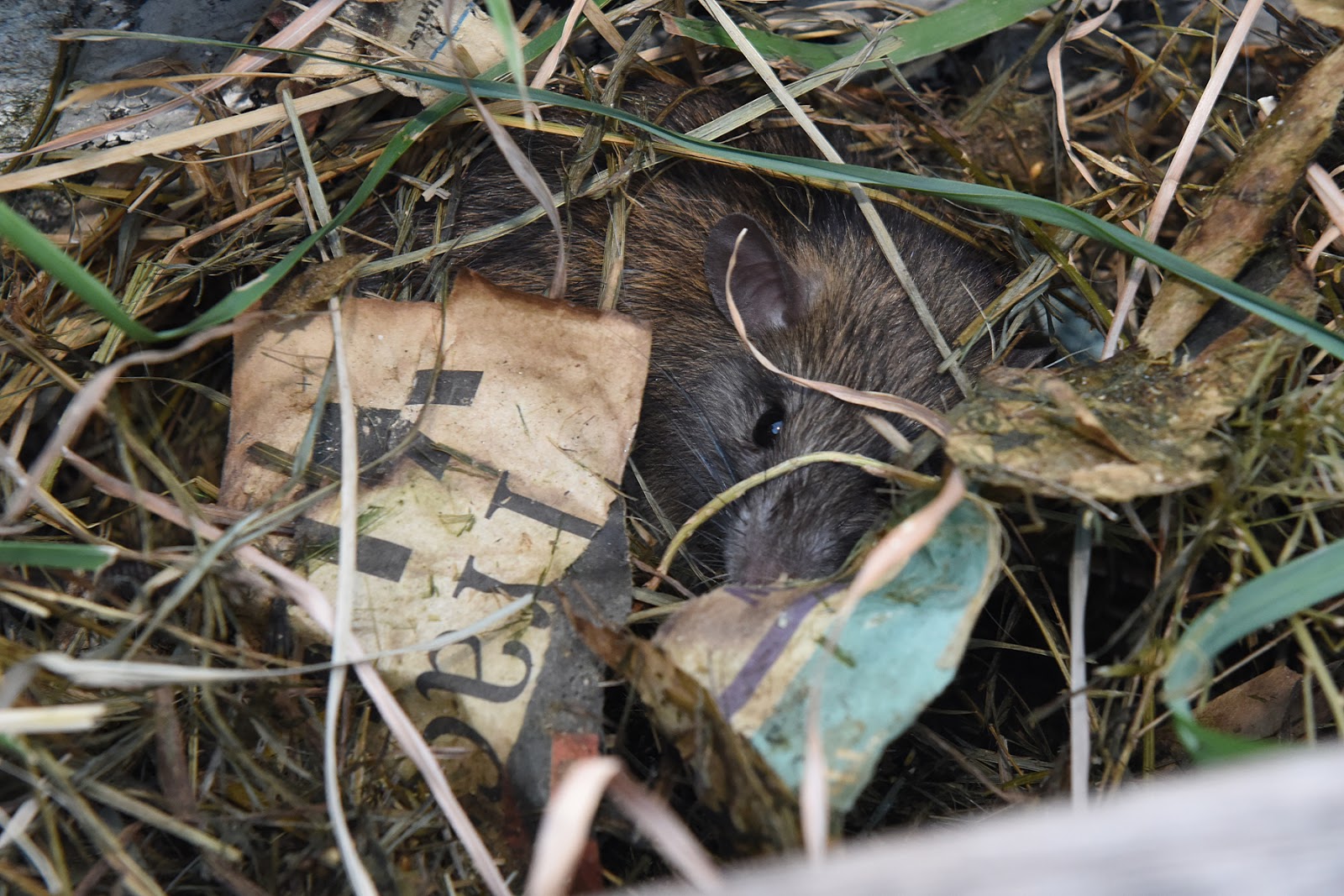
I recently found this black rat living in a neglected corner of our garden.
What if it were possible to deter unwanted rats and mice using just a scent? Not only would this reduce the deaths of rodents, it may also save the lives of native rats and mice, and reduce the number of accidental poisonings of dogs, cats and other animals with rodenticides.

Miguel Bedoya-Perez is a postdoctoral research associate in behavioural and chemical ecology. In a collaborative project between the School of Psychology and the School of Life and Environmental Sciences, at the University of Sydney, he is exploring the chemical, biological and evolutionary aspect of anti-predator behaviour in introduced and native rodents, in response to predator odours, working under the direction of Professor Iain McGregor.

Dr Bedoya-Perez took some time out of his day to answer our questions.

What’s your day job?

I am postdoctoral research associate in behavioural and chemical ecology at the University of Sydney. My current research focuses in the anti-predator behaviour rodents show when presented with the smell of predators, in particular cats.

What is the aim of your project?

The aim of this project is to isolate, identify and potentially synthesize the molecule, or molecules, in cats’ smell that scare rats, as a non-lethal alternative to poisoned baits for the management of rodents.

Why is there a need for more humane pest control?

Several species of rodents are a recognised world-wide as pests that destroy crops, spread disease and cause enormous damage to infrastructure. It is estimated that 280 million undernourished people worldwide could significantly benefit by reducing the losses in harvest due to rodents. However, these species are also known to develop resistance to many first, second and third generation poisons, making the development of alternative methods of control crucial. In Australia, as well as in other parts of the world, pest rodents can either share their habitat with other native species, or be themselves native species with population explosions caused by particular environmental conditions. Poisons and traps are not target specific, and have the potential to impact these other, sometimes vulnerable, populations. By tapping in the intrinsic fear rodents show for predators, we have the potential to develop a method of control that would be specific for rodents and at the same time non-lethal, reducing the impacts in other species. But also, because this response is evolutionarily stable, shown by laboratory rats that have been bred in captivity for generations and have never being in contact with any predators, there is little chance of development of resistance.

In a nutshell, how do scientists capture and reproduce a smell?

The process of capturing and reproducing the smell is somewhat complicated. But it basically involves acquiring sources of the smell, like fur, or collars, and using chemical procedures to obtain an extract, something no different to getting powdered instant coffee from brewed coffee beans. This extract can then be separated into its individual chemical components and screened to determine which of those components are responsible for inducing the fear response in rats. Once the individual chemical or chemicals are identified, chemists can, depending on the nature of the molecules, replicate the molecule in the lab.

What is the outcome of the research?

The method to use the smell will depend largely on the nature of the chemical and the management target. We need to first understand how stable the molecule is, its shelf life and the best ways for application. A stable long-lived molecule could potentially be added to materials, like the plastic covering of electrical cables or paint use in grain silos. But if the molecule is less stable and short lived, a regularly applied spray or diffuser may prove to be more effective.

What is the most interesting thing you’ve learned about cat fur so far?

I would say, probably the level temporal and individual variability of the fear-inducing odour in cats. Not all cats are scary, and this has nothing to do with breed, sex, age or even environment. We have cats that live in the same house, and are fed the same food, and one cat’s scent is scary while the other’s is not. We also found that some cats are not scary some times of the year, but scary at other times. We have a more questions than answers on why this could be, but we think this may be due to the seasonal shedding of coats from winter to summer, and also the process of domestication of cats.

How can people help with your project?

We are very thankful of all the help that we have received so far from vet clinics, pet groomers and cat owners giving us fur. 

The best way you can help is, if you have a cat, brush it regularly and keep as much fur in as possible in a plastic bag and post it to me within two weeks of collecting it. We are always looking for fur. If you want to offer extra help, add details to the fur sample (cat age, sex, breed, is it desexed or not, is it an indoor or outdoor cat, date of collection, etc.) try to collect all the fur per sample within a day or two, and finally, the more samples we get from the same cat several times over the year, the better.


Thanks Dr Bedoya-Perez for your time. You can follow Dr Bedoya-Perez on twitter @MA_BEDOYAPEREZ, or to donate cat fur, contact him via email at Miguel.bedoyaperez[AT]sydney.edu.au

Friday, October 9, 2015

What is a feral cat?

The late Lil Puss loved boxes, but hated veterinary hospitals and became very defensive. Was that enough to label her, even transiently, "feral"?

What do you mean when you use the term “feral" in relation to a cat? Do you use the word to refer to a cat that is a tad feisty? One that hisses at the vet? Or is this something you reserve for a cat you consider wild and untameable??

It turns out there is no real consensus about what “feral cat” means, which could be an issue as the welfare and management of feral cats depends very much on what we’re thinking when we use the term. I must admit to using the term “feral” to describe the behaviour of a small proportion of patients. For example, my own cat, the late Lil Puss, was a sweetie at home, but turned “feral” the moment I brought her into work. And by feral what I guess I mean is, beyond safe handling by any staff member, including myself. The use of the term in such circumstances is really shorthand for describing a type of behaviour.  

But there’s a dark side to the term. I grew up in a sociocultural context where the adjective “feral” immediately rendered a cat a status as lesser than. People would openly brag about how they (often inhumanely) dispatched with so-called feral cats. Yet one concern is that a normal reaction to a cat to a potentially terrifying situation (being handled by a strange human being) may risk it being deemed “feral”.

This cat was found approximately 20km from the nearest human settlement in the Northen Territory and immediately sought refuge when we walked past. Was it a lost moggie or a feral cat?
The question, “What is a feral cat?”, is the subject of a fascinating paper in the Journal of Feline Medicine and Surgery. According to the paper, which was published in 2013, the global population of domestic cats (Felis sylvestris catus) is around 272 million, of which the majority (58 per cent) are free-living and undomesticated.

There are concerns about this 58 per cent as a potential source of zoonotic diseases, as a reservoir for diseases that affect the other 42 per cent of cats, as a public nuisance and as predators of wildlife. In Australia, the Minister for the Environment, declared war on feral cats.

But who is the enemy? Depending on how you define feral, it could apply to any cat from one born and raised in the wild, hunting for survival, to a semi-owned cat or a grouchy housebound moggie.

According to a study of feline experts in the UK, a feral cat is one that is unapproachable in its free-ranging environment and can’t be caught without a trap. They are fearful of humans and have zero tolerance for human handling.
(As any vet can tell you, domesticated cats can demonstrate this exact behaviour, although in most cases one might expect a domesticated cat to acclimatise to human handling over a short period of time).

What the group could not agree on is whether actively or passively benefiting from human intervention (e.g. feeding) made a cat less feral. One potential compromise is the view that a feral cat can survive without human assistance, but will make the most of it if offered. Some semi-owned cats would fall into this category.

One surprise piece of information in the paper was that the earliest age at which any of the experts was willing to desex a cat was four months. As someone who was trained in early-age desexing, this seems a lost opportunity for population control as many of these cats would be easier to catch as kittens than as juvenile cats.

The experts were divided about whether feral cats could eventually be tamed.
The challenge with regard to population control is there is no inherent property of a cat by which it can be identified as feral. 

The final proposed definition of “feral cat” is this: “…a cat that is unapproachable in its free-roaming environment and is capable of surviving with or without direct human intervention, and may additionally show fearful or defensive behaviour on human contact.”

Reference


Tuesday, November 18, 2014

Counting cats: esimates of feral animal numbers

Feral cat in a tree in the Northern Territory.
Fact-checking is important, but easily overlooked. Some “facts” are born as estimates, published then cited and regurgitated without being question. This can be very problematic when the topic is emotive, for example the number of feral cats in Australia.

Some parties have a vested interest in talking the number up, others have a vested interest in talking the number down.

But it seems that there are plenty of sources willing to publish unverifiable figures without considering how indeed such figures were determined or indeed stating that this could be a gross under or over-estimate. We're probably all guilty of this at some stage or another, but its worth teasing out some of the implications.

For example, I’ve heard that there are more feral cats in Australia than there are people. That seems like an awful lot.

According to our Federal Environment Minister, Greg Hunt,
There are up to 20 million feral cats taking up to four native Australian animals a night. That is over 20 billion Australian native species being destroyed a year. 
You can read the interview here: http://www.abc.net.au/landline/content/2014/s4119674.htm

Those are staggering figures.

Such figures are cited to justify significant funding for eradication programs:

GREG HUNT: We're looking at an increase from a little above $40 million over four years to $90 million and what I have done is already spoken to the national head of Landcare. He has said that his groups want to be part of this. But what if the numbers are flawed? When we use big figures to justify spending big figures, shouldn’t we be taking steps to ensure that those figures are as accurate as possible?
The ABC’s Fact Check has provided a very insightful discussion here (great reading for anyone who has ever made a grand sweeping statement in an assignment and why your marker has circled it in red and written "source???") suggesting that the evidence base of Mr Hunt's claims in that instance was probelmatic.

Of course, it’s unlikely that anyone will be able to determine the absolute number of feral cats in Australia – they can’t really be counted one by one. The discussion highlights some of the challenges of estimate numbers of wild animals in general.